
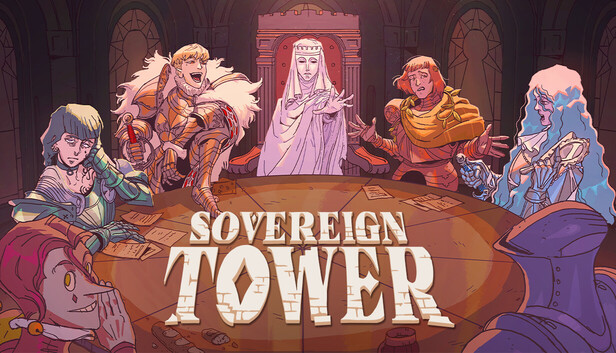
General Overview and Early-Reign Tips
Sovereign Tower loves this particular royal joke: the courier announces a crisis due next cycle, while every knight who could solve it is halfway through a three-cycle expedition. The court has made a flawless plan, provided disaster waits politely. It will not. The fix is to treat knight availability as a resource, just like gold or faction favor. Build your strange little Round Table, make the decrees that fit your ruler, and keep enough slack in the schedule to survive the consequences.
How a Cycle Works
A cycle is the game's main unit of time. Start by checking the treasury, faction levels, active objectives, quest deadlines, and returning knights. During the morning audience, petitioners bring decisions that can change faction favor, spend gold, recruit characters, or add quests. After the audience, visit the Tower's rooms to talk with knights, uncover hidden traits, repair armor, buy equipment, and handle other court business. Finish at the Round Table, where you assign available knights to accepted quests. Advancing from the Round Table moves time forward, reduces deadlines, progresses active assignments, and leads to debriefs when quests finish.
- Before the audience: Read the current main objective and note any treasury, faction, or deadline requirement.
- During the audience: Check the shown gains and losses before choosing. Accepting every request can create more work than your roster can cover.
- Before the Round Table: Repair armor, serve meals, equip the knights you intend to send, and speak with anyone whose traits remain hidden.
- At the Round Table: Assign urgent and story-critical quests first. Then spend spare capacity on rewards, training, or character goals.
- After results: Read the full debrief and its score breakdown. A result may reveal a trait, a hidden interaction, or a weak part of the assignment to fix next time.
How to Read a Quest Assignment
Every knight has six statistics: Strength, Agility, Charisma, Magic, Wits, and Luck. A quest may test several of them at once. One great score does not cancel weak scores elsewhere, and displayed statistics alone do not guarantee an outcome. Party size, traits, gear, meals, and special character checks also enter the royal arithmetic.
| Assignment factor | How to use it |
|---|---|
| Statistics | Match every listed requirement, not just the largest number. Equipment bonuses cannot raise a normal statistic above the 15-point cap. |
| Party size | Send the number of knights requested by the quest. Sending too few leaves a large built-in score penalty. The required-stat calculation also uses the party's average, so one badly matched knight can pull the result down. |
| Traits | Traits can add or remove score when they match a quest type or condition. Some also trigger an Unexpected Outcome. Hidden traits work before you discover them, so conversations and Alwena's investigations are valuable. |
| Meals | A favorite meal raises affinity and gives the knight a small quest-score bonus for that cycle. Feed the actual quest party rather than whoever happens to look hungry near the pantry. |
| Equipment | Use relics, mounts, and consumables to patch a missing statistic or add a useful condition match. Check whether an item is consumed, replaceable, or fixed to a knight before committing it. |
| Preferences | Liked and disliked quest types affect affinity, the knight's satisfaction and relationship level. Preferences do not directly change the normal quest score. An assignment can therefore be effective but unpopular, or beloved but mechanically risky. |
Angelica is an early lesson in why the character sheet is not the whole story. Her connection to animals can produce a kinder or unusual solution where another knight would simply complete the stated task. That does not make her the answer to every creature problem. Read the quest conditions, compare the full party, and decide whether you want the normal reward or a possible character-specific result. An Unexpected Outcome replaces the normal result and can replace its rewards as well.
Early Treasury, Repairs, and Round Table Priorities
- Keep a cash floor. Before buying a tempting sword, check whether the current objective or an audience decision requires treasury funds. There is no single perfect reserve because your choices change the pressure.
- Repair for the next assignment. Armor is a buffer against quest damage; it does not normally improve the quest score. Repairs also compete with equipment and other court costs, so fix the knight needed for the next dangerous quest and the knight held in reserve before polishing the entire court.
- Buy to solve a requirement. Early equipment should close a known stat gap, supply a useful quest tag, or shorten a dangerous assignment. A shiny upgrade with no immediate job is a tax on future panic.
- Recruit for coverage. Aim for different strengths, useful traits, and enough bodies to fill multi-knight parties. An eccentric specialist is often more valuable than another copy of your current best statistic.
- Protect affinity. Mix disliked assignments with liked quest types, favorite meals, and conversations. Knights whose affinity falls too low can resign, providing excellent coverage of the road out of town.
The Reserve-Knight Rule
Once you have more than a bare starting roster, keep one healthy, equipped knight unassigned whenever no urgent deadline forces your hand. Pick a flexible knight with usable scores in several areas, not necessarily your strongest hero. For longer assignments, try to leave two available knights or make sure another party returns before the next deadline. Random emergency quests can demand action within one cycle, and an excellent knight who returns three cycles later is still unavailable.
If an urgent quest appears while the useful roster is committed, open its card and check four things in order: response deadline, requested party size, required statistics, and damage range. Build the full party from idle knights, serve their favorite meals, then move gear to cover the narrowest stat gaps. If the resulting party still risks a critical failure, accept a lesser consequence or rewind to the cycle before the long assignments and shorten the schedule. Do not feed irreplaceable knights into a likely fatal result merely because the kingdom has produced paperwork marked urgent.
Fixed Mechanics and Variable Emergencies
| Fixed or state-based | Variable between timelines |
|---|---|
| Audiences lead into Tower preparation and Round Table assignments. | Random emergency quests may arrive at different points or in a different order. |
| A named quest has its own requested party size, duration, requirements, conditions, deadline, and damage range. | Your available roster, armor damage, treasury, and faction position depend on earlier choices and assignments. |
| Statistics, matched traits, meals, equipment, and party composition affect the result. | Chance-based traits and surprise emergencies can make two similar plans play out differently. |
| Knights remain unavailable while committed for the listed duration. | An emergency calendar from one timeline is not a reliable schedule for the next. |
Spoiler-Light: When to Rewind
A normal failure is often worth keeping. It may reveal a hidden trait, open a strange branch, or teach you that a displayed stat match missed an important condition. Consider a rewind when a death, missed main deadline, lost recruit, or faction collapse blocks the story or character route you actually want. Rewind to before the assignment or audience that caused the problem, then change one clear factor: party, equipment, meal, timing, or decision.
Keep a short timeline note with the cycle, decision, assigned knights, and result. Retained knowledge can unlock new Omniscient dialogue and earlier interventions, but rewinding replaces the later state of that timeline. Saving one character may also remove allies, artifacts, conversations, or opportunities gained after the point you erased. There is no universally optimal reign, Your Grace—only a growing collection of informed schemes and the lovable complications elected to carry them out.
Comments will load when you reach this part of the walkthrough.