
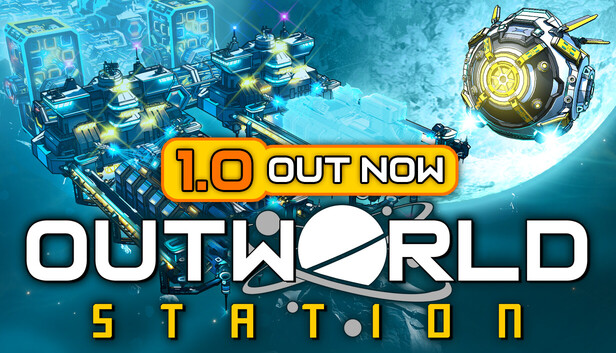
First Station Starter Guide
Your first Outworld Station usually breaks in a very specific way: the station looks busy, the machines look connected, and somehow nothing useful is moving. This is the no-belt moment. In a belt factory, you follow the item trail with your eyes. Here, you need to read links, inputs, outputs, power, gas, and storage as one system. The good news is that once that mental model clicks, the mess turns into a clean space factory instead of a floating junk drawer with ambition.
This starter route gets your first station stable before you chase bigger automation. The goal is simple: steady power, steady raw inputs, a small buffer, and short links you can read at a glance. Do not build like you are hiding a Factorio bus inside the walls. Outworld Station wants compact production cells, clear connector logic, and enough storage to absorb small stalls.
Starter Goal
Before expanding, your first station should have:
- A stable power source with extra capacity.
- Basic resource collection feeding storage.
- One simple production chain linked end to end.
- Enough buffer storage to see what is starving.
- A layout you can inspect without playing detective.
Opening Build Order
- Place your core station pieces first. Keep the starter hub, power, storage, and first production machines close together. Distance is not free when links and connectors become hard to read.
- Set up raw resource collection. Feed your first mined or gathered resources into storage before sending them to machines. A storage buffer gives you a visible clue: if it fills, production is the problem; if it empties, supply is the problem.
- Build power before more machines. If a new machine causes a station-wide power dip, remove or pause it and add power capacity first. A blackout is not a puzzle. It is the station saying you got greedy in electrical language.
- Create one short production chain. Link raw input storage to the first processor, then link that output to the next machine or output storage. A link is the game’s direct item route between buildings. Treat it like a belt you cannot see, then keep it short enough that you do not forget what it feeds.
- Add output storage after each key step. This is not elegant, but it is useful. Early buffers make stalls obvious and give you time to fix mistakes without the whole station stopping.
- Only then add automation. Once raw input, power, and the first product are stable, automate the repeated chores. Your first win is not a huge factory. It is not having to babysit every basic resource like a tired space intern.
Early Layout Pattern
| Zone | What Goes There | Why It Helps |
|---|---|---|
| Core | Hub, main storage, first power setup | Keeps the station readable and easy to recover. |
| Input side | Raw resource collectors and input buffers | Shows whether mining or gathering is keeping up. |
| Processing side | First machines and short connector links | Makes the no-belt flow easier to inspect. |
| Output side | Finished goods storage and upgrade materials | Prepares you for tech, shipyard, and expansion demands. |
Keep this pattern loose, not perfect. The point is to make the station readable from left to right or inside to outside. If you rotate every machine into a clever knot, future you will send a complaint to management. Future you is management.
How To Fix The First Stall
When production stops, do not rebuild everything. Check the chain in this order:
- Power: If machines flicker, slow down, or stop together, add power or turn off nonessential buildings.
- Input storage: If the input buffer is empty, increase raw collection or shorten the supply path.
- Output storage: If output is full, add storage or link it to the next consumer.
- Links and connectors: If both storage and machines look fine, inspect the actual links. One missing or wrong connection can make a whole cell look haunted.
- Gas and pipes: If a recipe needs gas or pipe flow, check that supply before blaming the machine. Silent pipe limits can throttle a setup while everything looks connected.
A strong recovery move is to add a temporary buffer between the stuck machine and the rest of the station. If that buffer fills, the next step is blocked. If it stays empty, the machine is not getting what it needs. This turns a vague stall into a clear yes-or-no test.
Before You Expand
Do not rush a second build cluster just because you unlocked new toys. Expand when your first station can run for a few minutes without manual feeding, power panic, or mystery shortages. The next stable milestone is a station that can produce basic parts, hold a small stockpile, and keep power above demand while you are busy elsewhere.
Once that is true, Outworld Station starts to open up. The asteroid handwork gives way to linked production cells, cleaner supply chains, bigger tech, ships, and eventually the kind of interplanetary industry that makes the first messy base look like a training accident with solar panels. Build small, read the links, fix the bottleneck in front of you, then scale.
Comments will load when you reach this part of the walkthrough.